I build and optimize machine learning systems, from clinical data pipelines to LLMs running on edge hardware.
I am a PhD candidate at Western University working across applied NLP, computer vision, distributed learning, and efficient AI systems. My experience combines Python and PyTorch model development with clinical data analysis, reproducible evaluation, and deployment on NVIDIA Jetson, Raspberry Pi, GPU servers, and secure HPC infrastructure.
Seeking Machine Learning Engineer and Applied Scientist opportunities where I can turn research and experimentation into practical, measurable AI systems.
Projects & Engineering Experience
Selected work in computational pathology, clinical machine learning, efficient LLMs, and embedded vision.
Research project · Computational pathology
Multimodal Breast Cancer Prognosis
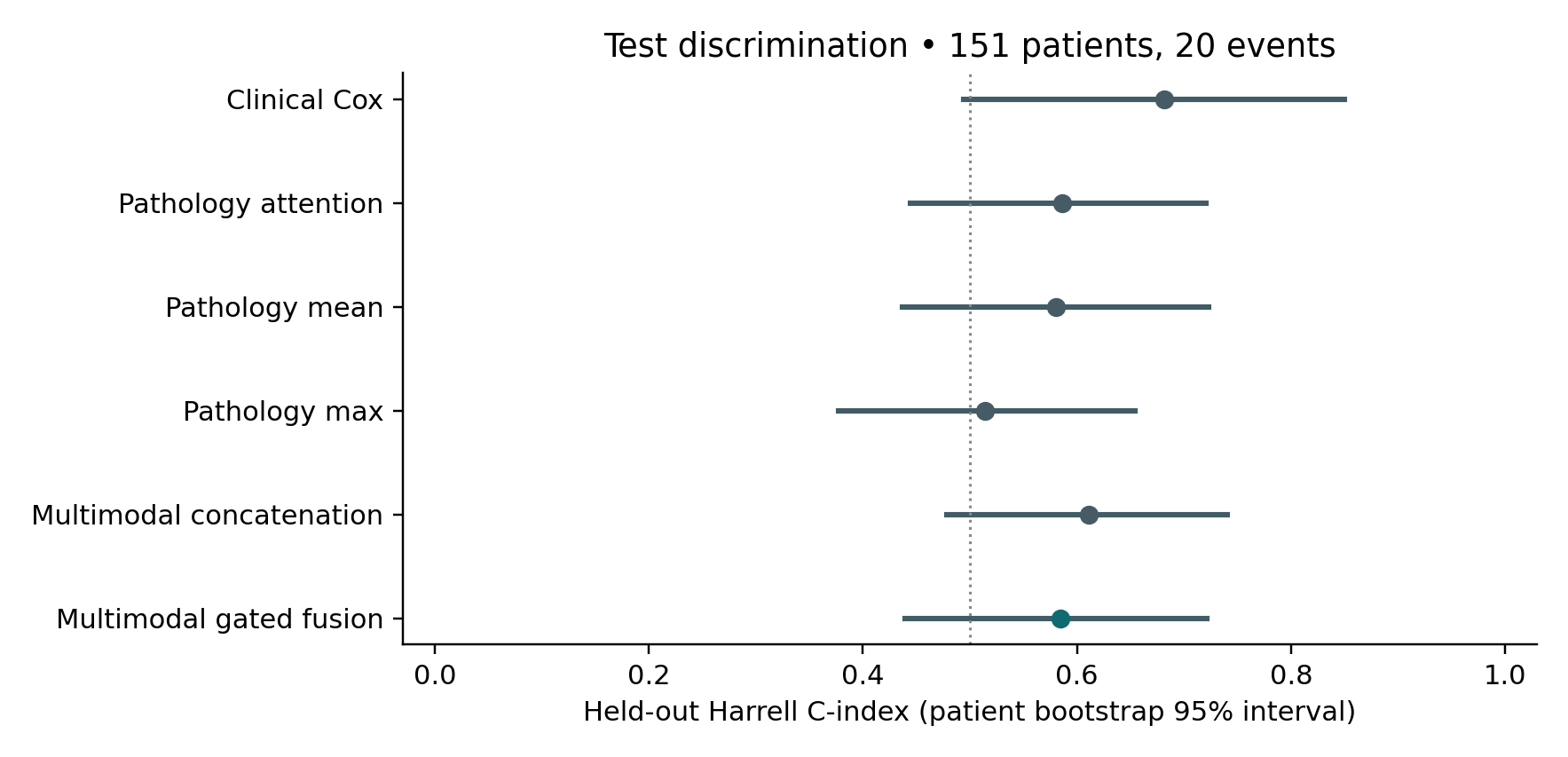
Can diagnostic tissue slides improve prediction of breast cancer progression beyond age and pathologic stage? I compared six survival models using 1,075 slides from 1,009 TCGA-BRCA patients. All slides from each patient stayed in the same training, validation or test partition.
Harrell’s C-index on 151 held-out patients with 20 events. Horizontal lines show 95% patient-bootstrap confidence intervals.
The clinical model had the highest test C-index (0.682). Pathology attention pooling reached 0.587 and gated fusion reached 0.584. The paired difference for gated fusion minus clinical was −0.097 (95% CI −0.335 to +0.125).
All 159 held-out slide filenames matched the Phikon v1 pretraining archive, limiting the independence of the image evaluation.
Professional experience · Healthcare AI
Clinical Risk Prediction & Healthcare Data Analysis
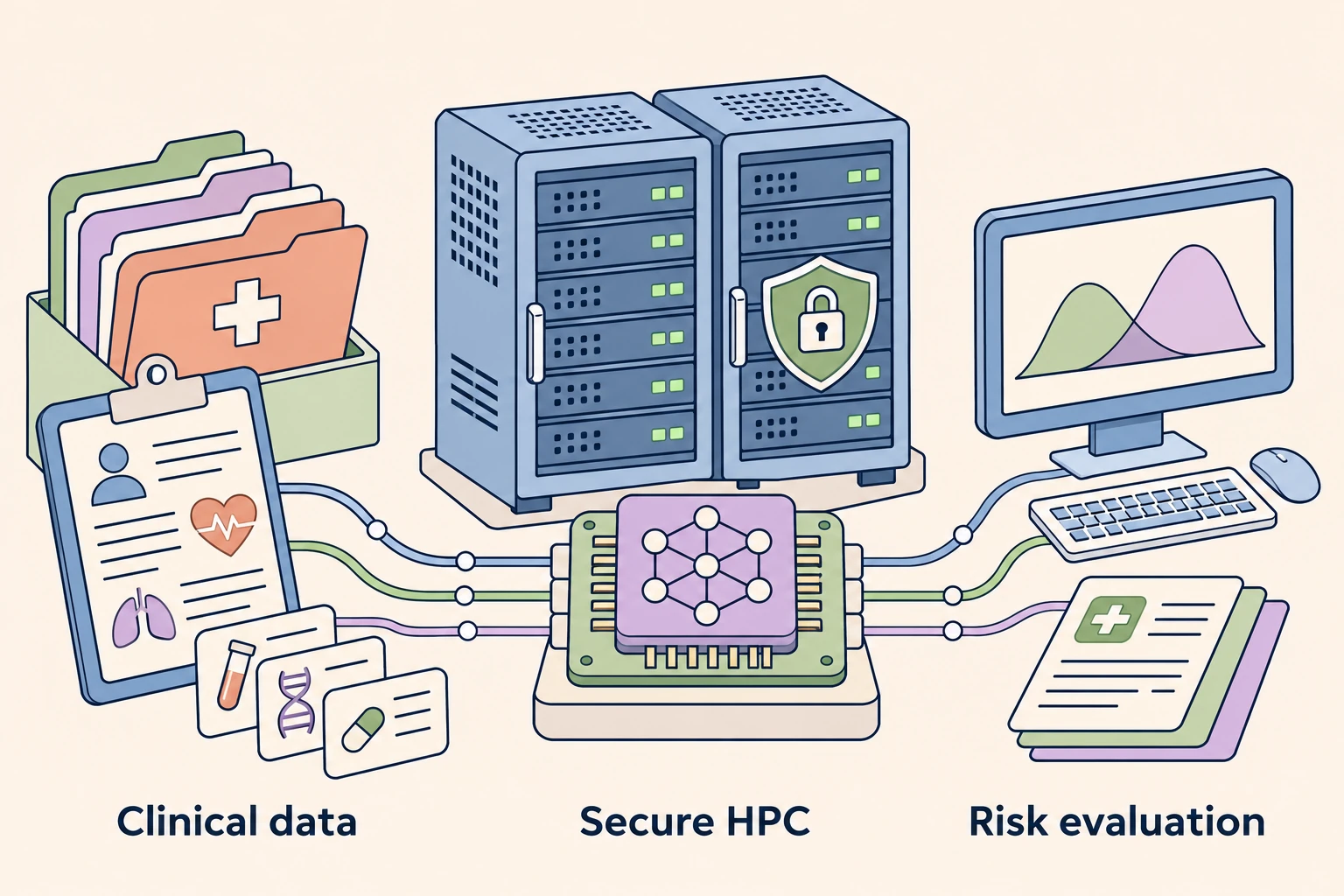
Conceptual system illustration; hardware and component placement are illustrative.
The problem
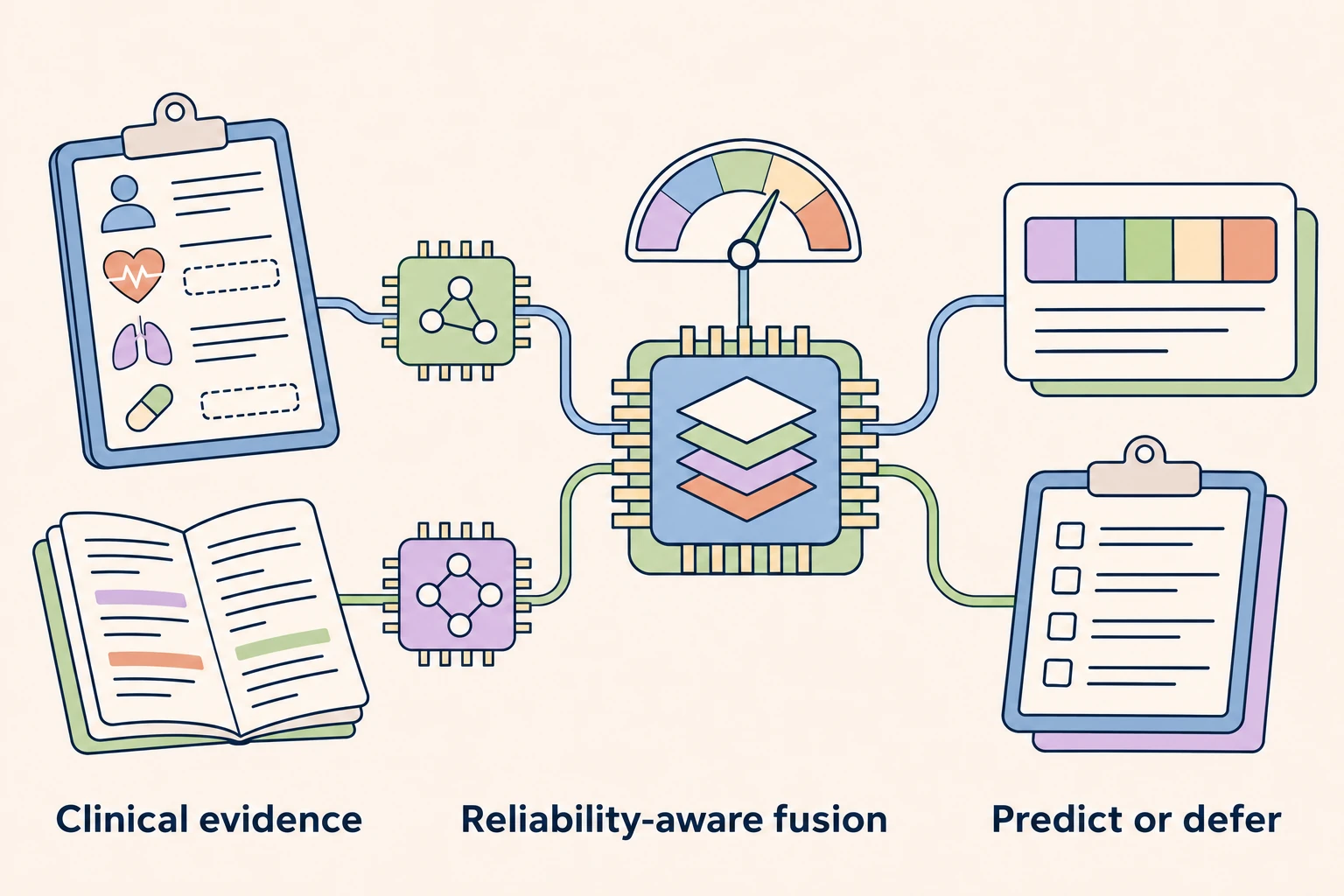
Clinical risk prediction requires extracting useful evidence from incomplete structured records and unstructured notes. I built an end-to-end pipeline covering data preparation, clinical text analysis, feature extraction, model training, and evaluation across three risk categories.
My contribution
Processed 12,841 emergency department records, including 7,924 labeled encounters, for clinical risk modeling.
Combined clinical-note features with structured patient data, evaluating Logistic Regression, Random Forest, XGBoost, TF–IDF text models, and multimodal fusion.
Addressed class imbalance and missing clinical evidence; compared the multimodal approach with a structured-data XGBoost baseline.
Built reproducible workflows with Python, scikit-learn, XGBoost, PostgreSQL, and MLflow in a secure HPC environment, with reusable NLP and evaluation components for future transformer integration.
Engineering relevance. Connects clinical data processing, multimodal modeling, and reproducible evaluation in the intended secure computing environment.
Results & evaluation
12,841Emergency department records; 7,924 labeled encounters
Three-category clinical risk prediction. Relative Macro-F1 improvement is approximately 36% over the structured-data XGBoost baseline. This clinical project evaluation is separate from the CRS-Triage paper benchmark below.
Additional longitudinal analysis: 19,323 GAD-7 and 25,757 PHQ-9 assessments, identifying 901 and 1,481 follow-up pairs respectively.
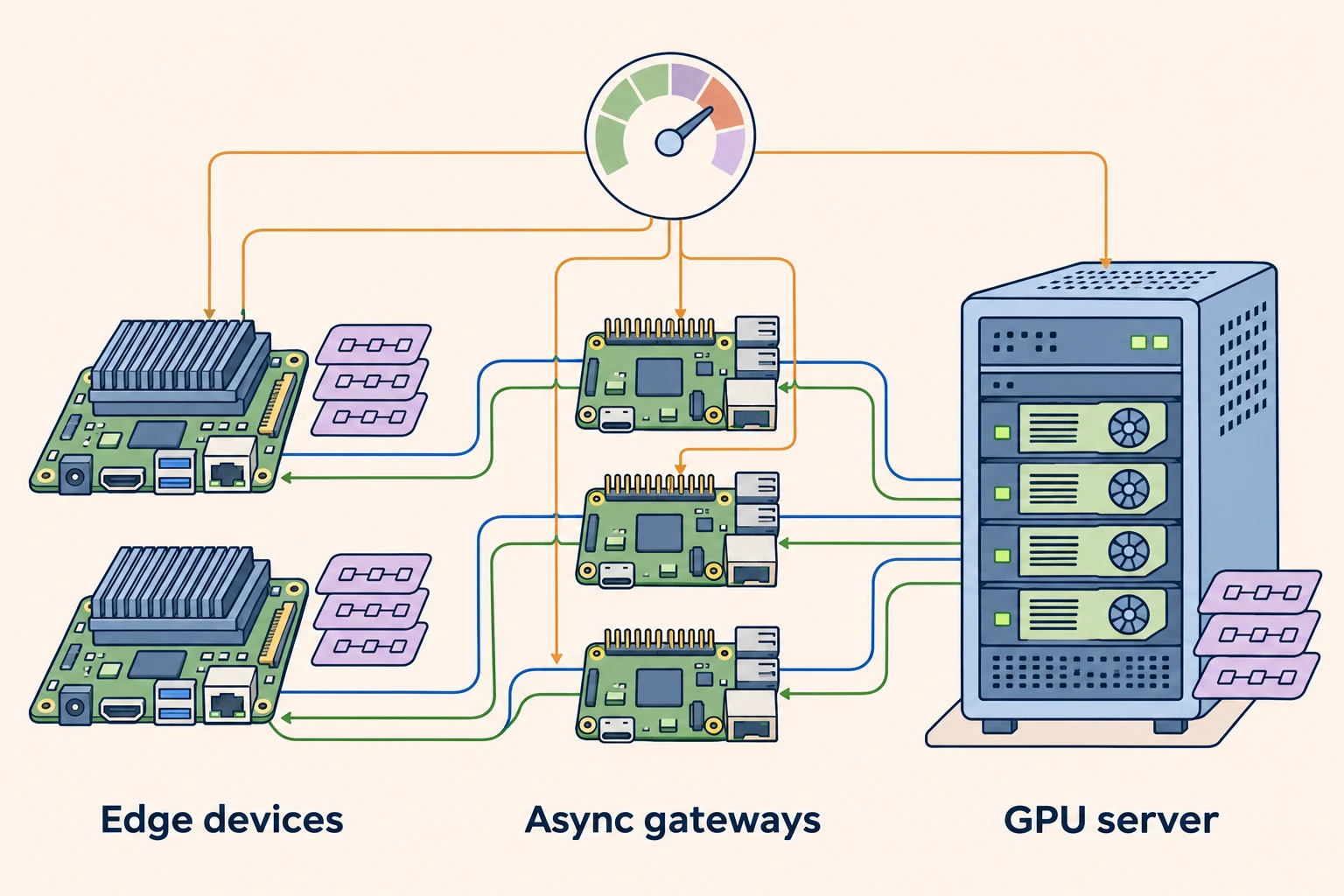
Conceptual system illustration; hardware and component placement are illustrative.
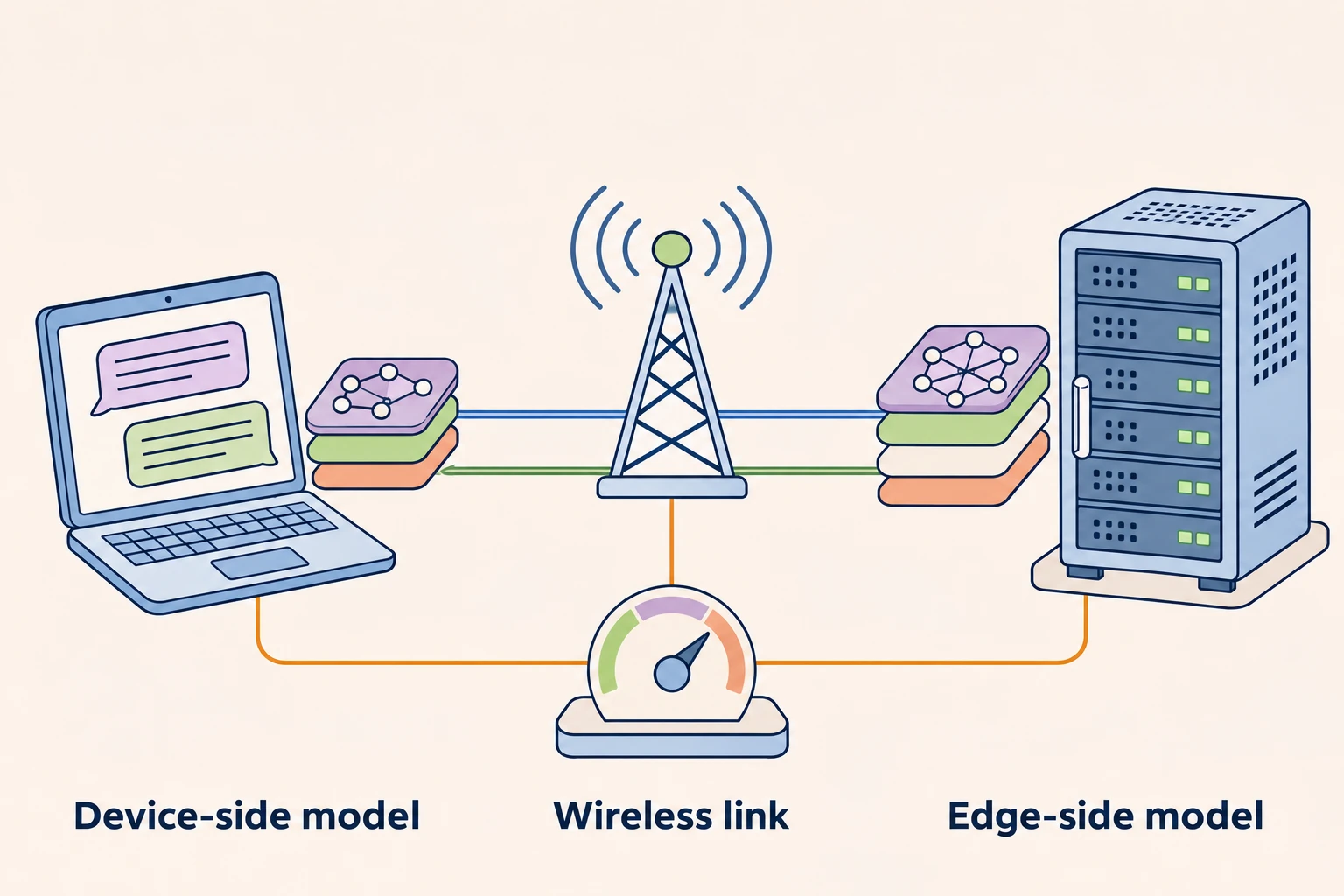
Concurrent LLM requests can strain device memory, compute capacity, and network bandwidth. I built a distributed inference system spanning two NVIDIA Jetson Orin Nano devices, three Raspberry Pi 5 gateways, and a GPU server.
My contribution
Implemented transformer model partitioning, remote inference, and asynchronous communication across heterogeneous hosts.
Developed dynamic scheduling for layer placement, GPU utilization, and network bandwidth allocation.
Optimized GPU execution, communication overhead, and KV-cache management.
Automated latency, throughput, GPU-memory, and energy benchmarking with Python and PyTorch for 10 concurrent clients and 20 transformer layers.
Engineering relevance. Brings model execution, communication, and resource scheduling together for serving LLMs on constrained edge hardware.
Results & evaluation
−40.1%P95 time-to-first-token; 1.82 s → 1.09 s
+54.0%Average throughput; 12.6 → 19.4 tokens/s
−24.8%Reported energy consumption per request
Benchmark: 10 concurrent clients and 20 transformer layers. P95 TTFT is compared with static model partitioning; average throughput increased from 12.6 to 19.4 tokens/s, with 24.8% lower energy consumption per request.
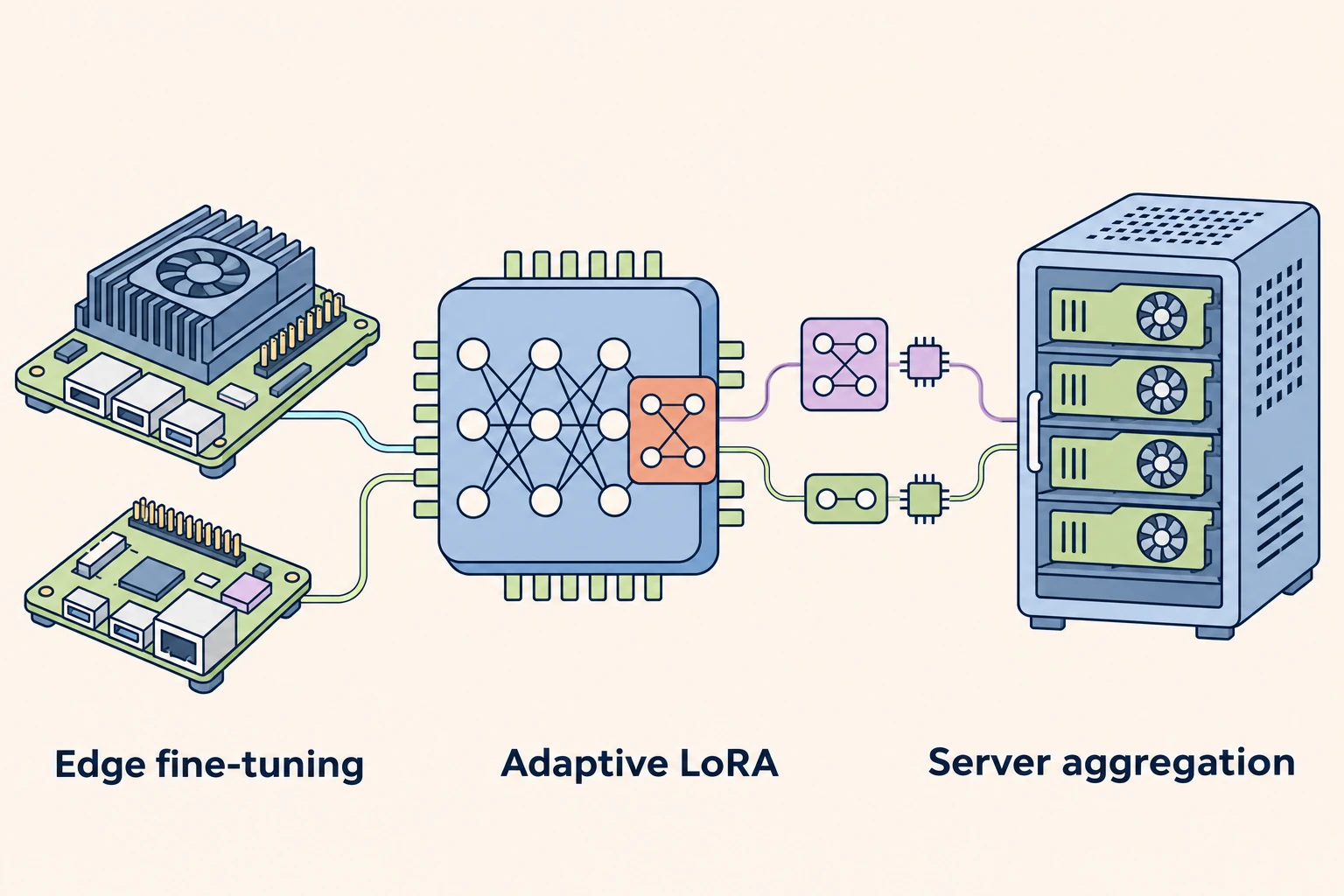
Conceptual system illustration; hardware and component placement are illustrative.
Adapting LLMs on heterogeneous edge hardware requires controlling GPU-memory use and communication cost. I built a distributed fine-tuning framework spanning Jetson Orin Nano, Raspberry Pi gateways, and GPU servers.
My contribution
Integrated PyTorch, Hugging Face Transformers, LoRA, and low-bit quantization for resource-efficient model adaptation.
Implemented hardware-aware LoRA rank selection with 4-bit and 8-bit quantization.
Developed adaptive resource scheduling and efficiency-weighted model aggregation.
Optimized low-rank adapter synchronization and built reproducible training/evaluation workflows with MLflow.
Engineering relevance. Enables model adaptation within edge-memory budgets while reducing training time and parameter-transfer overhead.
Results & evaluation
2.9 GBPeak GPU memory; 3.7 GB → 2.9 GB (−21.6%)
−24.2%Fine-tuning wall time versus fixed-rank LoRA
−31.4%Communication versus conventional federated LoRA
Fine-tuning wall time was also 10.7% lower than HetLoRA, with model performance within 0.5 percentage points of a full-precision reference. Memory, time, and communication comparisons retain their respective baselines.
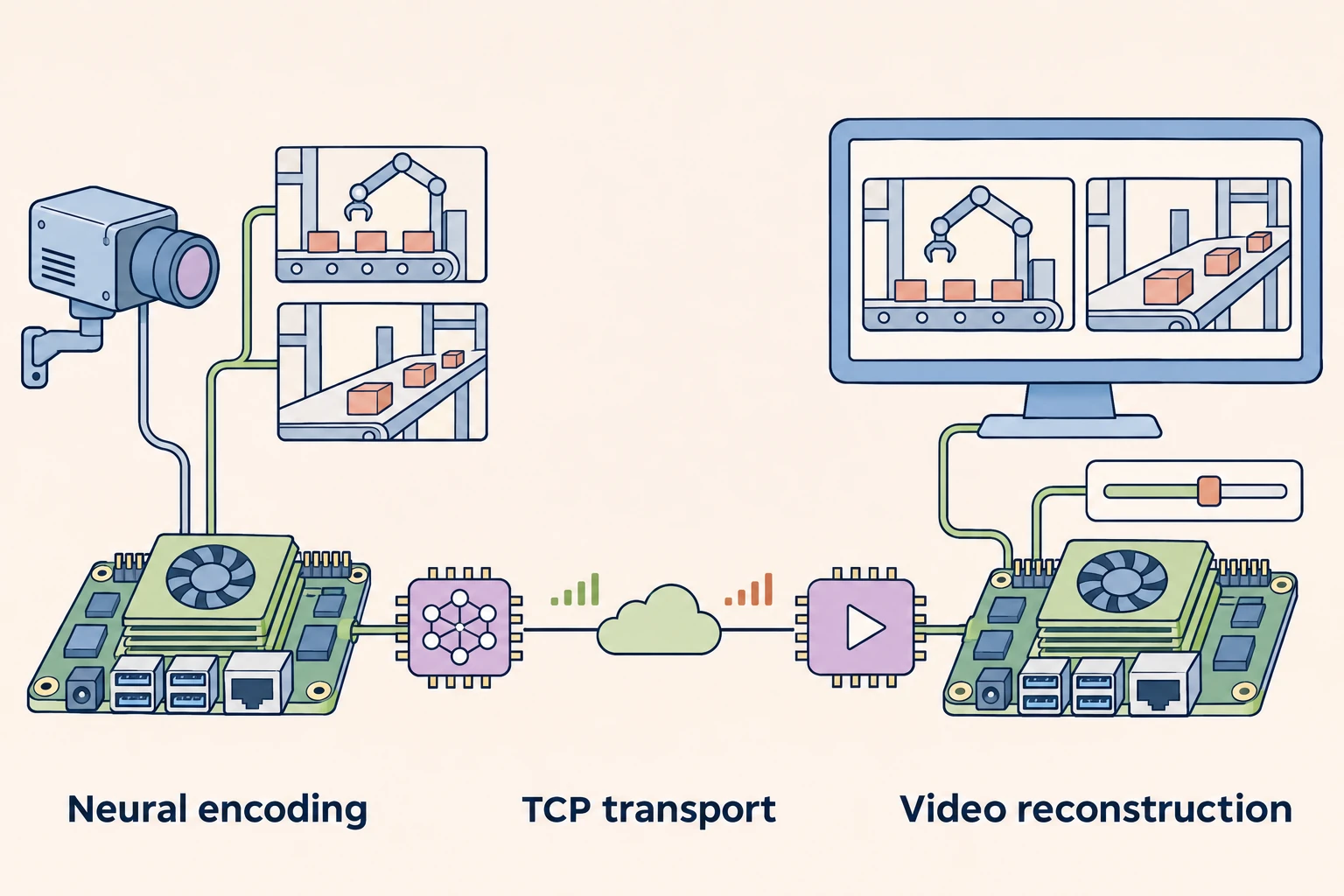
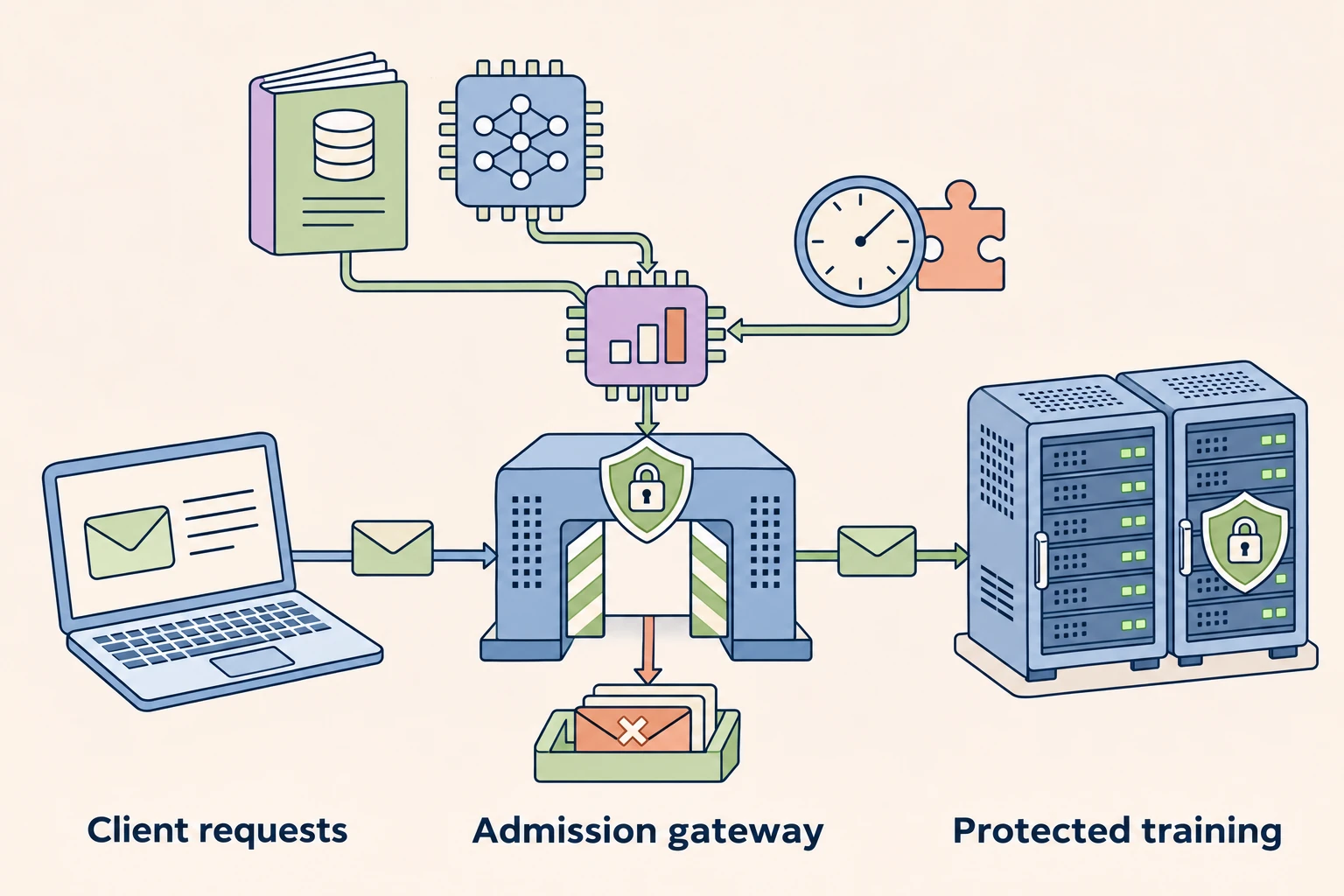
Conceptual system illustration; hardware and component placement are illustrative.
Industrial video monitoring must preserve useful visual content under limited bandwidth and changing channel quality. I deployed a neural video communication system on two NVIDIA Jetson Orin Nano devices.
My contribution
Integrated PyTorch neural encoding/decoding, CUDA acceleration, TCP communication, and PyQt5 monitoring interfaces.
Implemented two concurrent 256 × 256 video streams with end-to-end embedded-GPU processing.
Developed semantic compression and evaluated reconstruction across varying signal-to-noise ratios.
Integrated configurable SNR controls, real-time visualization, GPU inference, and network communication into one distributed application.
Engineering relevance. Combines embedded inference, neural compression, and network engineering in a working video-monitoring system.
Results & evaluation
≈5 FPSTwo concurrent 256 × 256 streams
190 msEnd-to-end processing latency per frame
8:1Compression; 87.5% less data than raw RGB
Under noisy-channel conditions, reconstruction improved by 2.9 dB in PSNR and SSIM increased from 0.81 to 0.89 versus a conventional transmission baseline. The 8:1 compression ratio is compared with uncompressed RGB video.
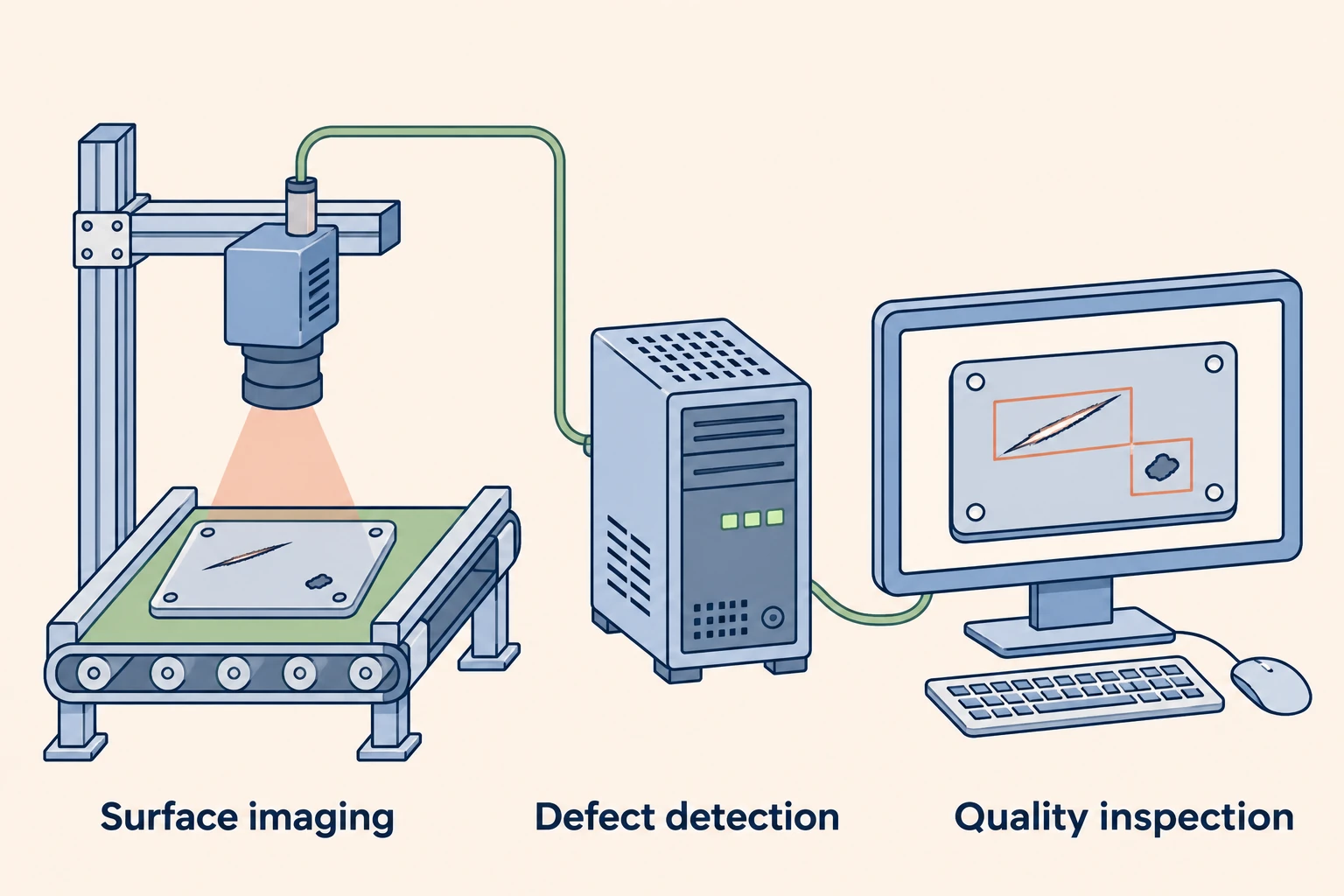
Conceptual system illustration; hardware and component placement are illustrative.
Manufacturing quality control requires identifying surface abnormalities quickly and consistently. I developed a deep-learning computer vision system for automated industrial surface inspection.
My contribution
Integrated image preprocessing, feature extraction, defect localization, and classification into an inspection pipeline.
Evaluated precision and recall for detecting surface abnormalities.
Optimized image processing and model inference to support efficient defect screening and reduce reliance on manual inspection.
Engineering relevance. Applies computer vision and inference optimization to a concrete manufacturing quality-control workflow.
Results & evaluation
>93.2%Reported defect-detection precision
>90.1%Reported defect-detection recall
<120 msImage processing and inference per image
Evaluation of industrial surface-abnormality detection, with the image processing and inference pipeline optimized for automated quality inspection.
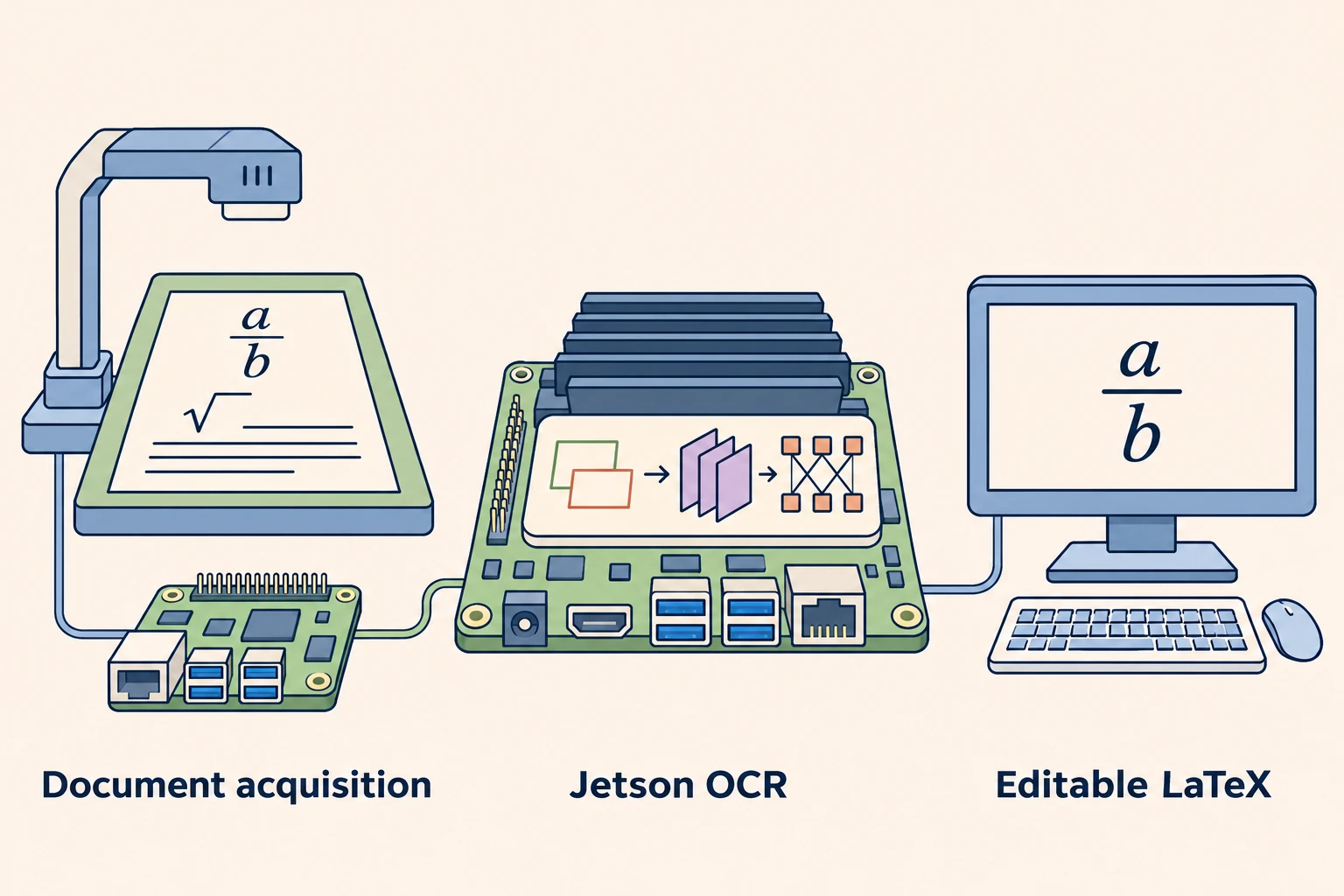
Conceptual system illustration; hardware and component placement are illustrative.
Mathematical expressions in scanned documents require recognizing both symbols and their spatial structure. I built an end-to-end system that detects formulas and converts them into editable LaTeX.
My contribution
Integrated Python, OpenCV, PyTorch, and YOLOv5 for formula detection, preprocessing, sequence recognition, and LaTeX generation.
Implemented a CNN–Transformer recognizer for symbol and mathematical-structure recognition.
Deployed inference on NVIDIA Jetson Nano with Raspberry Pi image acquisition.
Used TensorRT and FP16 to optimize embedded inference, and connected localization with structured expression generation and editable export.
Engineering relevance. Connects visual recognition with embedded deployment and reusable, editable mathematical output.
Results & evaluation
94.2%Formula detection mAP@0.5
86.5%Expression-level LaTeX exact match
1.15 sLatency per image; 1.74 s → 1.15 s
Symbol-recognition accuracy was 96.1%. TensorRT and FP16 optimization reduced end-to-end latency by 33.9%, from 1.74 to 1.15 seconds per image. Detection mAP, symbol accuracy, and expression exact match are separate measures.
G. Qiang, Y. Chen, T. Liu, D. Rotenberg, E. H. Kim, and F. Fang.
AAAI Conference on Artificial Intelligence, 2027. Under review.
Public arXiv preprint on selective triage with incomplete clinical evidence. The AAAI 2027 submission remains under review.
Reported evaluation
0.742Macro-F1 ± 0.006; full coverage
9.6%Under-triage at full coverage
4.7%Under-triage among accepted cases at 80% coverage
418,100 encounters from 201,252 patients in MIMIC-IV-ED v2.2; results averaged over five seeds. Full coverage: base evidential fusion had Macro-F1 0.707 and under-triage 13.1%; CRS-Triage had 0.742 and 9.6%, with over-triage rising from 14.5% to 15.1%. At 80% coverage, evidential-certainty selection on the same classifier had 5.9% under-triage versus 4.7% for the CRS confidence score.
Y. Chen, G. Qiang, X. Xie, B. Wang, D. Cai, M. Diyan, T. Liu, and F. Fang.
IEEE Communications Standards Magazine, early access, 2026.
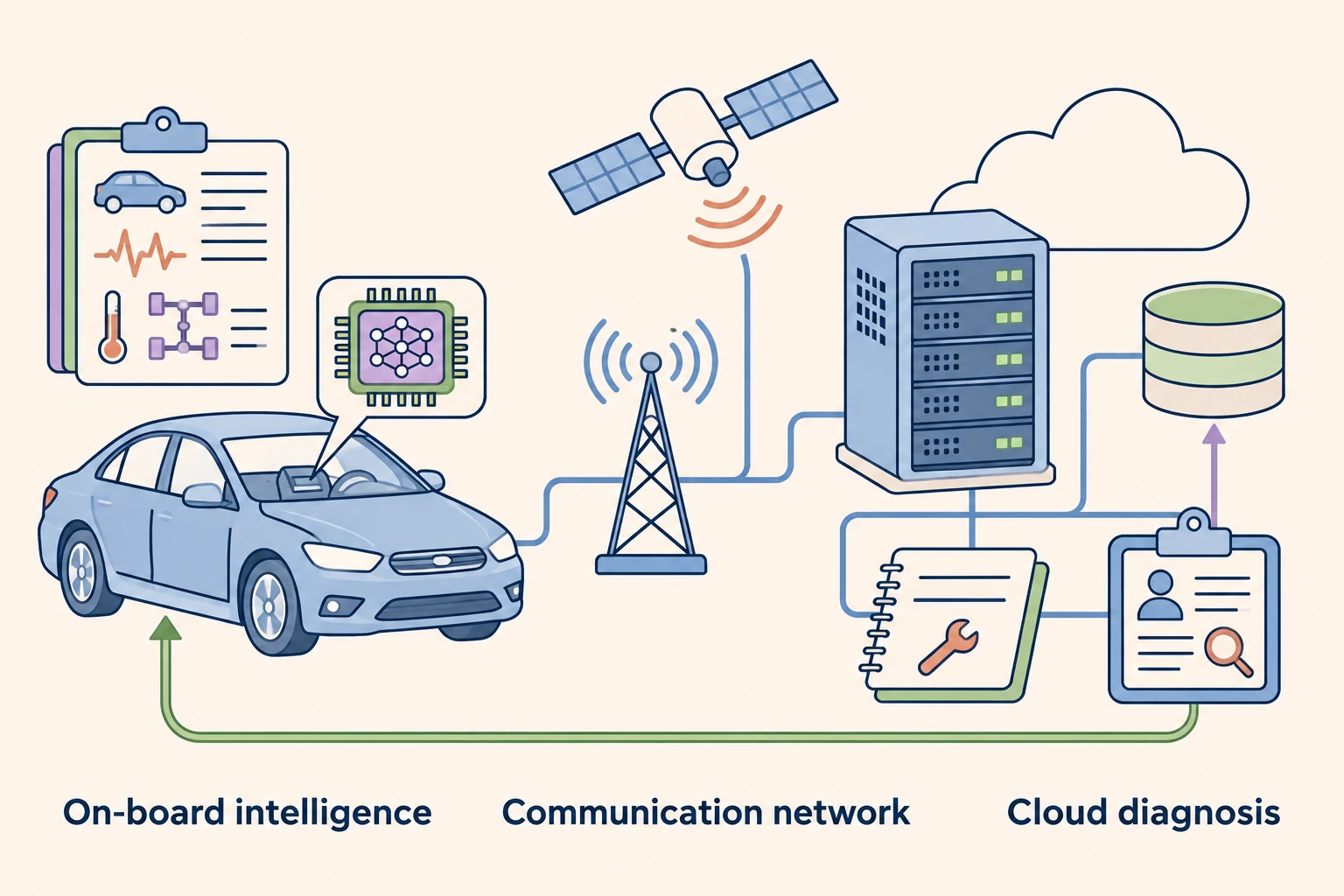
Explores large language models for personalized vehicular health diagnosis.
Reported prototype and case-study scope
1B + 30BGemma3 on board + LLaMA in the cloud
1–2 minEnd-to-end prototype processing time
3 profilesSynthetic driver profiles across three fault scenarios
Co-authored prototype study using NVIDIA Jetson Nano and a cloud server with three RTX 3090 GPUs. EngineFaultDB supplied the sensor data. Fault localization, query generation, and solution synthesis took 1–2 minutes depending on request complexity. The measured prototype used a local-network connection; this timing is not a measured satellite-link benchmark.
20 / 20Clients participating in the CIFAR-10 experiment
100 roundsResNet-18 training with heterogeneous clients
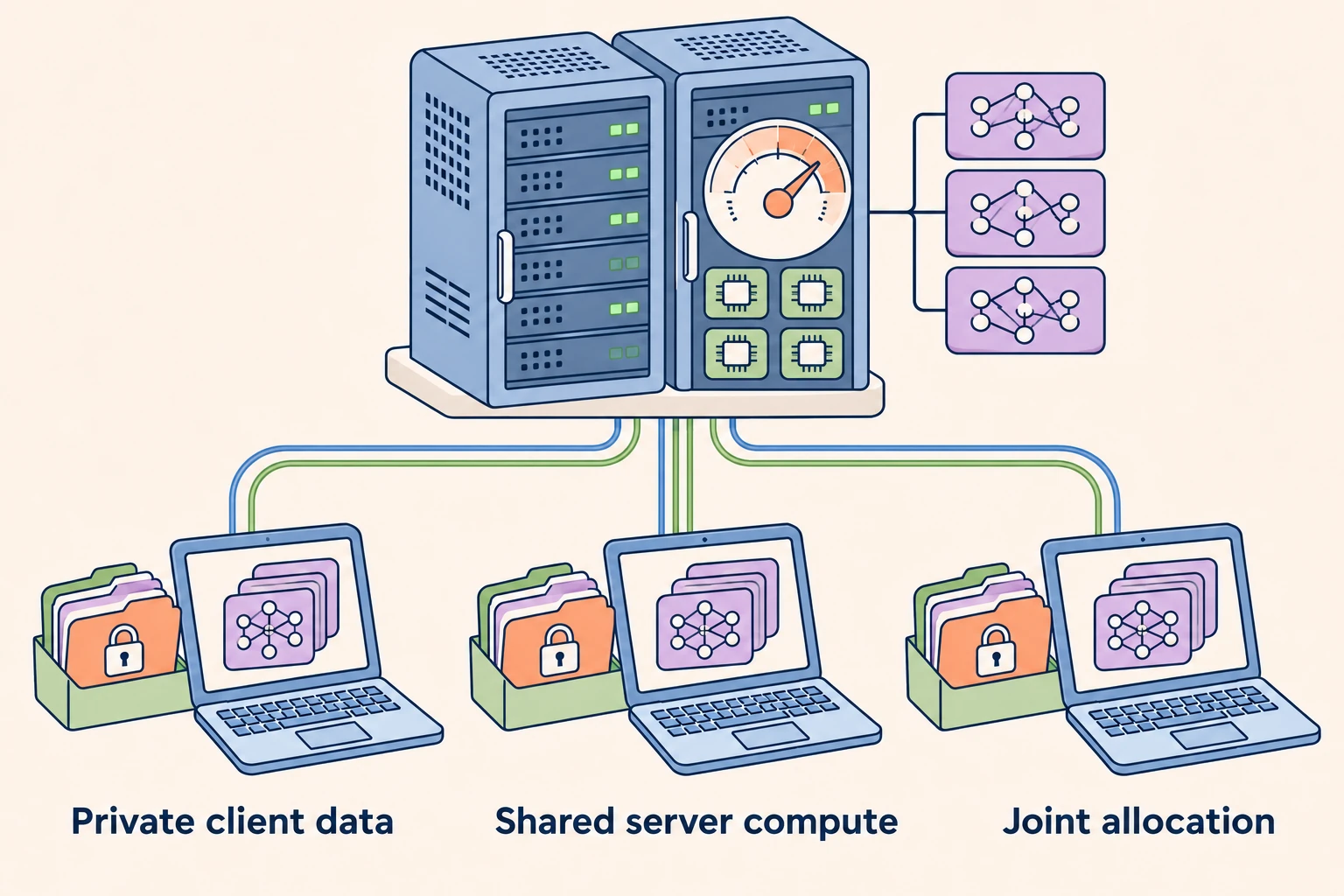
Table IV reports zero energy-depleted clients for both proposed methods at 5, 10, 20, and 50 clients. In the 50-client setting, AdaptSFL had 14 depleted clients. The separate 20-client CIFAR-10 experiment used non-IID data (four classes per client); reported baselines retained 4–16 participating clients.
CIC-IDS2017 features were reduced from 78 to 50 using RFE. Eleven TVAE models generated 10,000 samples per attack class. The six-hidden-layer classifier used an 80/20 train/test split; hyperparameters were selected with grid search and three-fold cross-validation. These are paper-reported benchmark results, not production attack-blocking rates.
PhD Candidate, Electrical and Computer Engineering
Sep 2022 – Present
Western University · London, Ontario, Canada
GPA: 91%
Relevant coursework: Machine Learning, Deep Learning, Reinforcement Learning, Convex Optimization, Distributed Computing, Wireless Communication Systems, Statistical Learning, Advanced Algorithms.
B.Eng., Computer Science and Technology
Sep 2018 – Jun 2022
Shanghai University · Shanghai, China
GPA: 87/100
Relevant coursework: Data Structures and Algorithms, Artificial Intelligence, Computer Vision and Image Processing, Probability and Statistics, Linear Algebra, Database Systems, Operating Systems, Computer Networks, Software Engineering.
Special Award, Enterprise Track, Global AI + Radio Challenge · International AI and Wireless Communication Competition (2026)
Advanced to Second Round, AI Data Scientist Competition · China Merchants Bank, 10th Digital Finance Training Camp (2026)
Mitacs Accelerate Research Funding · Mitacs Canada (2026)
Fourth Place, Shanghai Innovation and Entrepreneurship Competition (2021)
Second-Class Academic Scholarship, Shanghai University (2019)
Languages: English (Fluent), Mandarin Chinese (Native)
Contact
I am interested in Machine Learning Engineer and Applied Scientist roles involving clinical NLP, computer vision, efficient LLMs, and deployed edge AI systems. I would welcome the chance to discuss how my research and implementation experience could contribute to your team.